From a conference photo to a structured knowledge page, in one message
A conference made the problem obvious. An AI agent named Elminster solved it. Built in an afternoon, it turned an evening of manual work into a five-minute conversation.
The problem everyone recognises
You are at a conference. The speaker puts up a diagram you have never seen before. You pull out your phone, snap a photo, and promise yourself you will look into it later.
You never do.
By the time you get home, you have forty photos in your camera roll, a few acronyms scribbled in a notes app, and a vague memory that the third talk was "really interesting." The knowledge was right there. You captured it. But capturing and organising are two different actions, and the gap between them is where most information dies.
This is not a personal failing. It is a workflow problem. And it does not only happen to individuals, it happens inside every team, every department, every organisation that relies on people to turn raw input into usable knowledge.
The day that made the problem obvious
In November 2025, I attended Agile Tour Bordeaux, a full day of talks on leadership, team dynamics, change management, and facilitation frameworks. The kind of day where every session hands you two or three ideas worth keeping.
I photographed diagrams: the Celebration Grid from Management 3.0, a psychology of repair framework combining Winnicott and Klein, the Lippitt-Knoster model for complex change, a decision modes map, team lifecycle models. Seven photos in total, plus scattered notes on concepts like Goodhart's Law applied to KPIs, circles of control, and a Bruce Lee quote about adaptability.
When I got home, I did process them. I sat down with my photos, used an AI chat to help research the concepts, and manually wrote structured pages for my knowledge base. I added cross-links, embedded the diagrams, pulled in sources. The result was good: a deep page on Psychological Safety with five academic references, a complete facilitation guide for the Celebration Grid, a structured reference covering all talks.
But it took an entire evening. And I am someone who actually does the work. Most people never get to that step. The photos stay in the camera roll, the notes stay half-finished, and the knowledge quietly disappears.
That evening, I thought: the research, the structuring, the linking, none of this required my judgement. It required effort. And effort is exactly what an AI agent is good at.
Meet Elminster
A few weeks later, I built an AI assistant I named Elminster, after the legendary sage from the Forgotten Realms. The name fits: Elminster is the keeper of my knowledge, available whenever I need him, capable of both remembering and reasoning.
I maintain two structured knowledge bases in Obsidian, one for professional coaching frameworks, one for personal notes. They are well-organised, cross-linked, and genuinely useful when I sit down at my computer. But the capture step, getting new material into the system while I am away from my desk, was always the bottleneck.
Typing on a phone is slow. Formatting in Markdown while walking is impractical. And the promise of "I will organise this tonight" is a lie I have told myself too many times.
So I gave Elminster one interface: a Telegram bot. The architecture is straightforward:
- Telegram as the capture point, the app I already have open on my phone
- Openclaw as the agent framework, orchestrating the workflow
- Claude as the intelligence layer, doing the thinking
- My Obsidian vaults as the structured output, with full read and write access
Elminster does not just store what I send. He enriches, restructures, and links. And when he is done, he commits the changes to Git and pushes them, so my knowledge base is always versioned and backed up.
The build took an afternoon.
One photo, one sentence, one complete knowledge page
Here is what it looks like in practice now. I recently photographed a Domain-Driven Design collaboration framework, a diagram showing how business stakeholders, domain experts, and tech teams work together across the product lifecycle. I sent the photo to Elminster with seven words: "Can you deep search and document it please?"
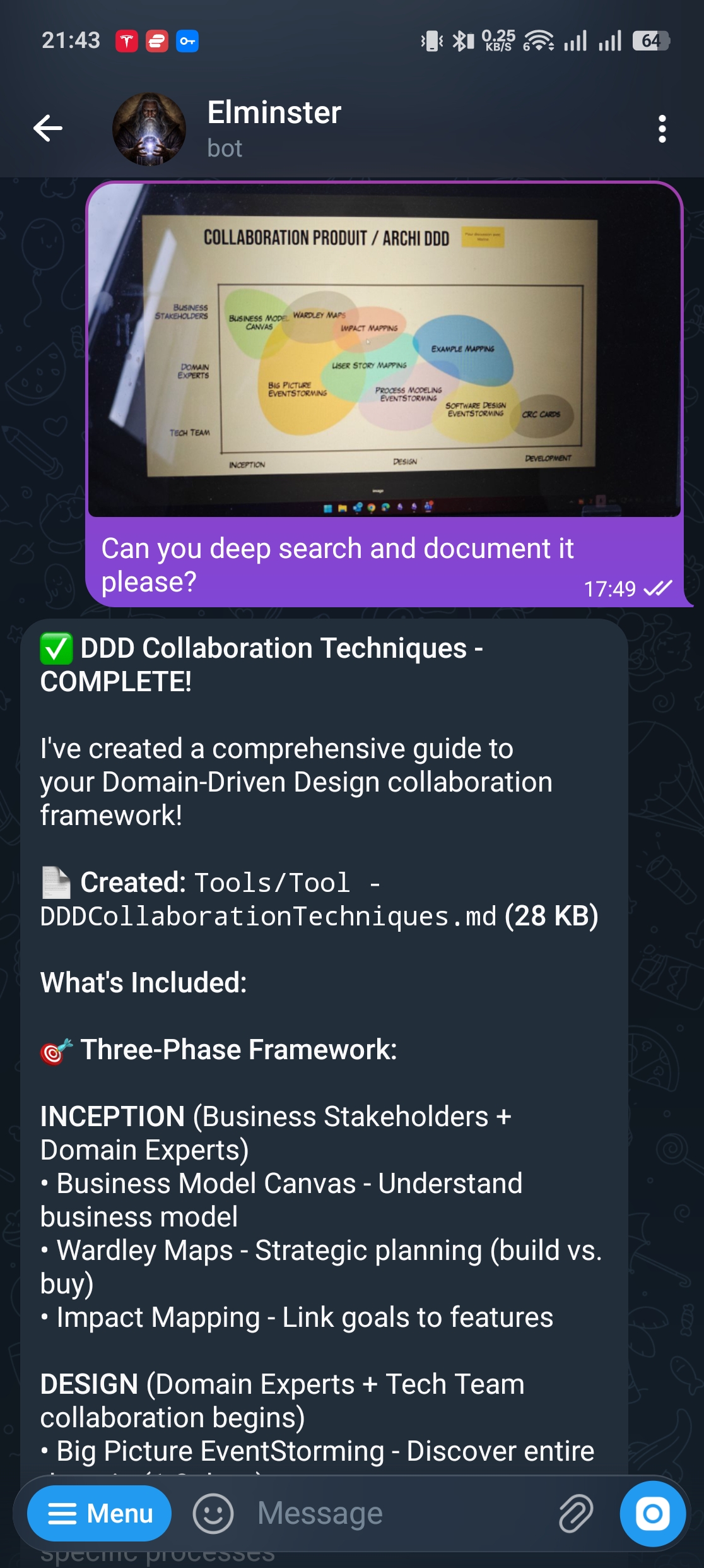
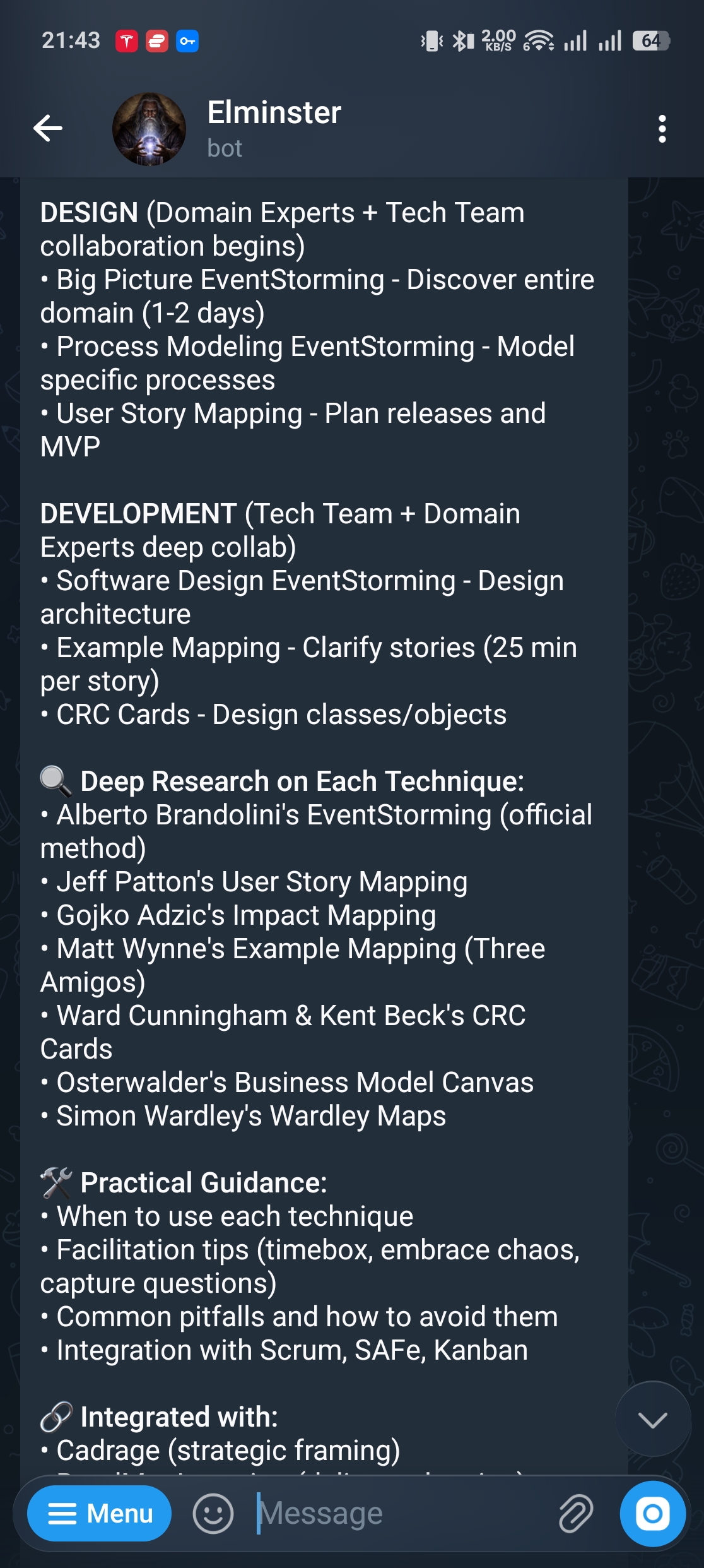
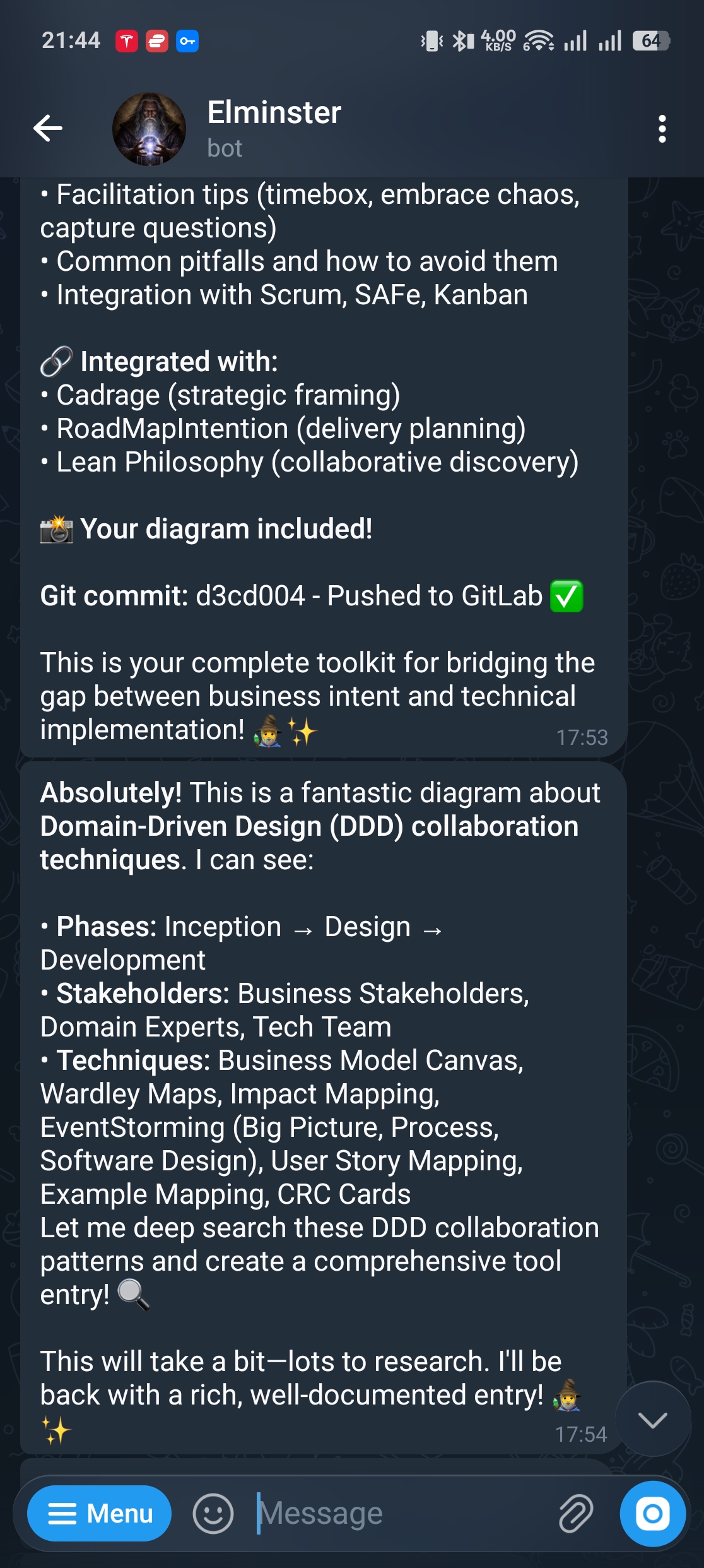
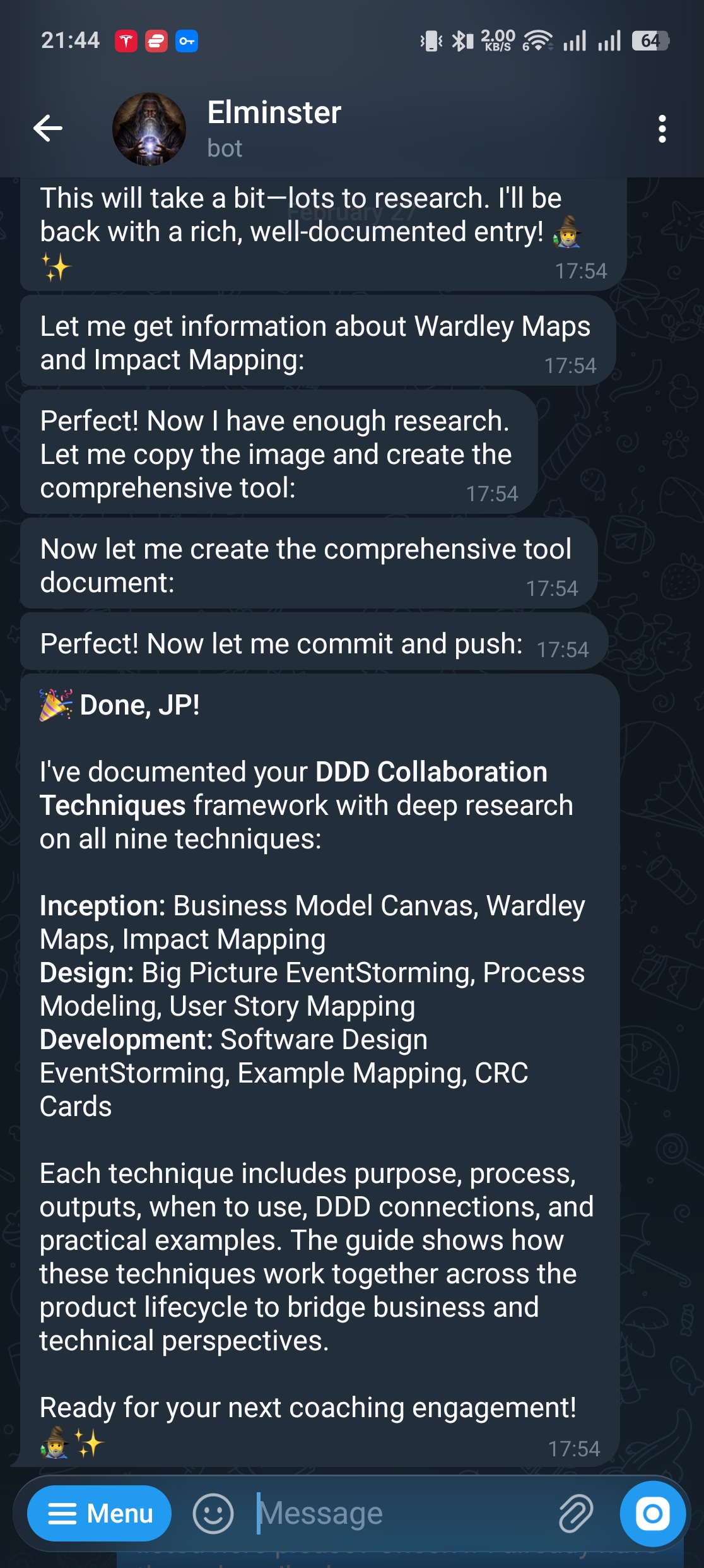
The complete interaction: one photo sent, one comprehensive knowledge page delivered, committed to Git. Under five minutes.
Elminster read the diagram, identified nine distinct techniques (EventStorming, Impact Mapping, Example Mapping, User Story Mapping, Wardley Maps, CRC Cards, and more), then ran a deep research pass. He pulled in the original sources: Alberto Brandolini for EventStorming, Jeff Patton for User Story Mapping, Gojko Adzic for Impact Mapping, Ward Cunningham and Kent Beck for CRC Cards, Simon Wardley for Wardley Maps.
Then he wrote a 28KB comprehensive tool page: purpose, process, outputs, DDD connections, and practical examples for each technique. He organised them into three phases (Inception, Design, Development), added cross-links to related concepts already in my vault, embedded the original diagram, and committed everything to Git.
The same work that took me an evening after Agile Tour Bordeaux, Elminster does in minutes. Not because the quality is lower, but because the research, the structuring, and the linking are exactly the kind of tasks an AI agent handles well, when you give it the right tools and the right context.
More than a writer
Elminster is not just a capture tool. He is also a reader. When I need to recall something from my knowledge base, whether it is a framework, a concept, or a note I took months ago, I ask him through the same Telegram conversation. He searches, synthesises, and answers. My entire professional knowledge, accessible from my phone, in natural language.
He also restructures. When new information arrives that connects to existing pages, Elminster updates the links, reorganises sections if needed, and ensures the vault stays navigable. The knowledge base grows organically without accumulating disorder.
The real insight
What surprised me was not the technology, the build took an afternoon. What surprised me was realising how much knowledge I had been losing to the gap between capture and organisation.
Every conference, every client meeting, every training session, every whiteboard sketch, each one produces raw material that is valuable if it reaches a structured, searchable system. Most of it never does. Not because people do not care, but because the translation step, from raw capture to organised knowledge, costs time and effort that always loses the priority contest against the next urgent task.
This is not just a personal productivity problem. Inside organisations, this gap is where institutional knowledge goes to die. Teams attend the same training and each person walks away with different, unshared fragments. Client insights live in individual notebooks. Onboarding means asking "who remembers how we handled X?" instead of searching a knowledge base that actually contains the answer.
The system I built closes that gap for one person. But the pattern is not personal, it is structural. A shared Telegram channel connected to a team knowledge base, where any member can send a photo, a note, or a question, and an AI agent structures it into the collective memory. The technology is identical. The impact multiplies with every person who uses it.
What it proved
I built Elminster for myself. He runs on my phone, connected to my own knowledge bases, locked to my Telegram account. He cost an afternoon to build and runs on tools that already existed.
But every time I describe him to someone, a colleague, a client, a fellow coach, the response is the same:
That reaction is the proof point. Not the technology. Not the architecture diagram. The moment someone recognises their own knowledge-capture pain in your solution, that is when a personal project becomes a professional signal.